Effective aid
In traditional development aid, often only part of the money reaches the people. With direct cash transfers, help flows straight into the hands of the families.
Where the money in development aid ends up
Many development projects do important work. But between a donation and its impact there are often many stages: organisations, consultants, tenders, transport and elaborate controls. Each stage creates costs that never reach the people.
Administration, consulting, reporting
A large share of the funds does not go to the people but into administration, external consulting, reporting, monitoring and evaluation. ActionAid estimated that so-called technical assistance alone, meaning consultants, training and studies, accounts for around a quarter of official development aid [1].
Tied aid
Aid is often tied to buying goods and services in the donor country. According to the OECD, this can increase the cost of a development project by up to 30% [2].
Costly in-kind aid
Food and goods have to be bought, transported and stored. A cost analysis showed that, per transfer, cash is always cheaper to distribute than food [3].
Cash straight into people's hands
Unconditional cash transfers do away with buying, storing and transporting goods. Families decide for themselves what they need most: a repaired roof, school fees or start-up capital for a small business. Studies show that this form of aid is not only cheaper but often also more effective.
More effective than in-kind aid or counselling
A cash transfer of the same cost often achieves more than an elaborately designed support programme [4].
2.5 times the effect
Every cash transfer generates 2.5 times its value in additional economic activity in the region, with hardly any price increases [5].
Own income and greater well-being
Recipients of cash transfers built up income and savings and reported significantly higher well-being [6].
100% of your donation arrives
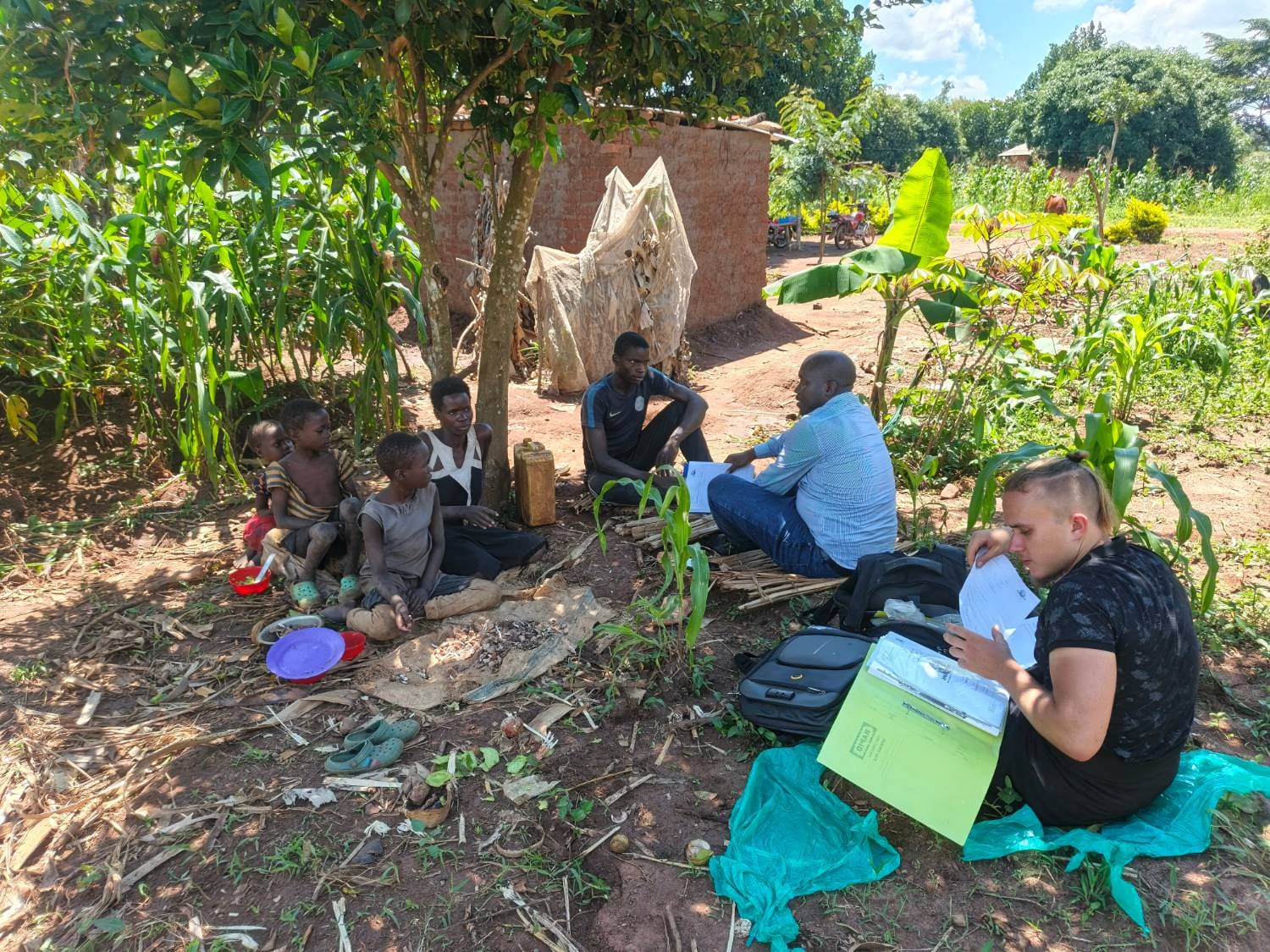
We hand over the cash transfers ourselves, directly on site or via mobile money. There are no other organisations, intermediaries or supply chains in between.
All costs for travel, administration and documentation are covered by our members through their membership fees. We work on a purely voluntary basis. We also follow up with the families after one month and after one year ourselves, in cooperation with universities rather than expensive consultancies.
If you donate 100 euros,
we hand over 100 euros more to families living in extreme poverty.
Without deductions for administration, travel or staff.
Sources
- [1]
ActionAid International (2006). Real Aid 2: Making Technical Assistance Work. Johannesburg: ActionAid.
- [2]
OECD Development Assistance Committee. Untied aid. https://www.oecd.org/en/topics/sub-issues/oda-standards/untied-aid.html
- [3]
Margolies, A., & Hoddinott, J. (2015). Costing alternative transfer modalities. Journal of Development Effectiveness, 7(1), 1–16. https://doi.org/10.1080/19439342.2014.984745
- [4]
McIntosh, C., & Zeitlin, A. (2018/2023). Using Household Grants to Benchmark the Cost Effectiveness of a USAID Workforce Readiness and Nutrition Program in Rwanda (Cash Benchmarking). Innovations for Poverty Action / UC San Diego. https://cega.berkeley.edu/collection/gikuriro-rwanda-cash-benchmarking/
- [5]
Egger, D., Haushofer, J., Miguel, E., Niehaus, P., & Walker, M. (2022). General Equilibrium Effects of Cash Transfers: Experimental Evidence from Kenya. Econometrica, 90(6), 2603–2643. https://doi.org/10.3982/ECTA17945
- [6]
Haushofer, J., & Shapiro, J. (2016). The Short-Term Impact of Unconditional Cash Transfers to the Poor: Experimental Evidence from Kenya. The Quarterly Journal of Economics, 131(4), 1973–2042. https://doi.org/10.1093/qje/qjw025